
Why Is Electrical Performance Testing an Important Part of Stage Lighting Reliability Validation?
In the development and manufacturing of professional stage lighting equipment, Electrical Performance Testing is one of the most important procedures for ensuring stable operation, safety, reliability, and compatibility with power supply conditions around the world. Whether it is an LED-based wash light, profile light, spot light, or a beam fixture using a discharge lamp source, the electrical system serves as the foundation for the fixture’s overall performance.
In real-world applications, stage lighting fixtures are widely used in concerts, theaters, television studios, cultural tourism productions, and large-scale live events. Since power grid conditions vary across countries and regions, fixtures often encounter voltage fluctuations, momentary voltage drops, and changing load conditions on-site. If the power supply system lacks sufficient design margin, issues such as brightness instability, system rebooting, component damage, or even show interruptions may occur.
Therefore, systematic electrical performance testing has become a critical method for verifying fixture operation under various input voltage conditions and evaluating overall product reliability and engineering suitability.
Purpose of Electrical Performance Testing
The primary objective of electrical performance testing is to verify that stage lighting fixtures can operate reliably under different power supply conditions while ensuring that the power system has sufficient design margin.
First, the fixture must be tested for power stability under both rated voltage and voltage fluctuation conditions. Engineers evaluate whether the fixture can start up normally, operate continuously, and maintain stable performance of the light source, driver system, and control system when the input voltage changes.
Second, the testing process evaluates the design margin of the power supply system. In the professional lighting industry, switching power supplies are typically required to maintain approximately 20% (IP20 fixture)load margin to avoid excessive thermal stress, shortened component lifespan, or reduced reliability caused by continuous full-load operation. By measuring the actual power supply loading rate, engineers can determine whether the selected power supply is appropriate for long-term operation.
Additionally, electrical performance testing helps identify potential electrical design issues before mass production, including excessive output ripple, insufficient power conversion efficiency, abnormal current fluctuations, and other electrical risks.
Electrical Performance Testing Scope
Electrical performance testing includes the measurement and analysis of multiple critical parameters related to both the fixture and its power supply system.
First, engineers measure the fixture’s input current, total power consumption, and Power Factor (PF) during operation. These parameters indicate energy efficiency and compatibility with power distribution systems. For large-scale concerts, theaters, and television studios, a higher power factor helps reduce the load on the electrical grid and improves overall power utilization efficiency.
Second, special attention is given to evaluating the operating status of the power supply module, including:
- Input voltage
- Input current
- Output power
- Output ripple
Output ripple is one of the most important indicators of switching power supply quality. Ripple level should be as lower as possible, in general, maintaining ripple levels within approximately 50mV to 200mV is considered desirable. Excessive ripple may negatively affect the stability of LED drivers, control circuits, and communication modules.
The testing process also verifies whether each power supply output voltage meets design specifications, including:
- LED driver voltage
- Main control board supply voltage
- Other power supply outputs
Stable output voltage is essential for ensuring proper fixture operation.
For stage lighting fixtures utilizing active cooling systems, fan operating voltage is also measured. Abnormal fan voltage may reduce cooling efficiency and consequently affect the lifespan of LED or discharge light sources.
Finally, the actual loading rate of the switching power supply is calculated. By analyzing the relationship between rated power and actual load power, engineers can determine whether sufficient safety margin exists for long-term reliable operation.
Electrical Performance Testing Conditions
To simulate power supply environments across different regions worldwide, testing is typically conducted under multiple input voltage conditions.
For regions using 220V/50Hz power systems, test voltages generally include:
- 198V/50Hz(-10%)
- 220V/50Hz(Rated Voltage)
- 242V/50Hz(+10%)
For regions using 110V/60Hz power systems, testing is conducted at:
- 98V/60Hz(-10%)
- 110V/60Hz(Rated Voltage)
- 121V/60Hz(+10%)
By simulating low-voltage, nominal-voltage, and high-voltage conditions, engineers can comprehensively evaluate fixture stability under power fluctuations. These test conditions also represent the majority of real-world electrical environments encountered globally.
Electrical Performance Testing Equipment
Accurate and reliable test results require professional electrical measurement equipment and data acquisition systems.
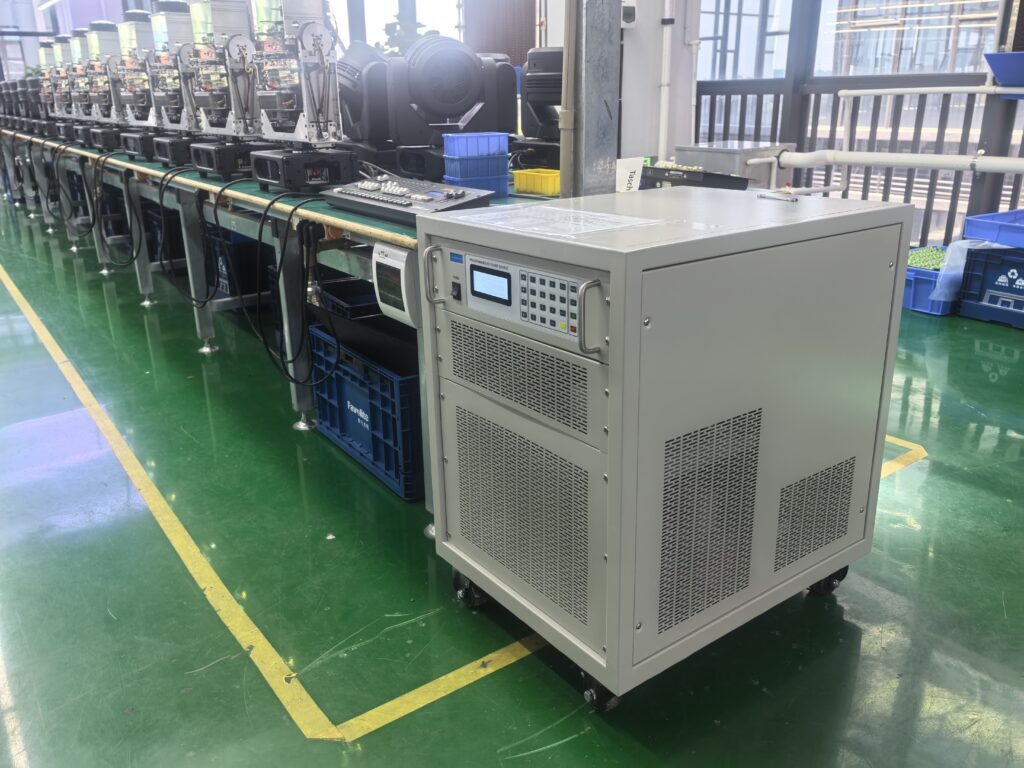
A Variable Frequency Power Supply is one of the core instruments used in electrical performance testing. By adjusting output voltage and frequency, engineers can simulate power supply conditions found in different countries and regions while maintaining stable and controllable input power.
A Digital Multimeter is used to measure voltage, current, resistance, and power supply output parameters, making it an essential tool for evaluating electrical system performance.
The oscilloscope is used for testing the ripple of the power supply output.
A Current Clamp Meter enables fast measurement of fixture input current and branch circuit current without modifying the electrical circuit.
In addition, engineers use dedicated data recording sheets to document and analyze all electrical parameters in real time, ensuring traceability and consistency throughout the testing process.
Electrical Performance Testing Process
A complete electrical performance test begins with equipment preparation.
Engineers first verify that the fixture is functioning properly and connect the testing equipment to the variable frequency power supply and data acquisition system.
Next, input voltages are sequentially adjusted according to the testing plan, including:
198V/50Hz, 220V/50Hz, 242V/50Hz, 98V/60Hz, 110V/60Hz, and 121V/60Hz.
At each voltage level, the fixture is powered on and evaluated for startup performance, operating stability, and proper functionality of all subsystems.
After stable operation is achieved, engineers record key electrical parameters, including:
- Input current
- Input power
- Power factor
- Power supply output voltages
- Output ripple
Fan operating voltage and switching power supply loading rate are also measured to verify that the overall system design meets reliability requirements.
Once all testing is completed, the collected data is analyzed and compared against design specifications. A comprehensive electrical performance testing report is then generated.
Contact Us for Fixture Verification
Through our professional electrical performance verification service, you will receive:
✓ Complete Test Report (PDF)
✓ Detailed Electrical Test Data Records
✓ Product Safety and Reliability Assessment
✓ Engineering Optimization and Improvement Recommendations
Professional electrical performance testing helps identify potential issues related to power supply design, load matching, and electrical stability before products reach the market. This improves product reliability, reduces operational risks, and enhances overall design performance.
Whether you are an OEM/ODM stage lighting brand, rental company, system integrator, distributor, or production company, we can provide professional electrical performance validation services for your moving head spot lights, beam lights, wash lights, profile lights, and other professional stage lighting products.
Conclusion
For professional stage lighting equipment, outstanding optical performance and impressive lighting effects are important, but a stable and reliable electrical system is the true foundation of long-term operation.
Through comprehensive electrical performance testing, manufacturers can verify a product’s ability to operate under various global power supply conditions, identify potential design risks early, and continuously improve product quality.
For rental companies, system integrators, distributors, and OEM/ODM brands, products that have undergone rigorous electrical performance verification offer higher reliability, lower failure rates, and stronger market competitiveness.
FAQ
·Why do stage lighting fixtures need to be tested under different voltage conditions?
Power grid standards vary across countries and regions, and voltage fluctuations are common in real-world applications. Testing under different voltage conditions verifies that the fixture can operate reliably across a wide range of power environments.
·What is Power Factor (PF)?
Power Factor is an important indicator of electrical energy utilization efficiency. The closer the power factor is to 1, the more efficiently the equipment utilizes power from the grid, making it more suitable for large-scale event and entertainment applications.
· Why is switching power supply loading rate testing important?
Loading rate indicates whether sufficient design margin exists within the power supply system. For long-term reliability, it is generally recommended that continuous operating load remain around 80% of the power supply’s rated capacity.
·What problems can excessive power supply ripple cause?
Excessive ripple can negatively affect LED driver stability and may lead to flickering, control abnormalities, communication failures, and shortened lifespan of electronic components.
·What types of stage lighting fixtures require electrical performance testing?
All professional stage lighting products should undergo electrical performance testing, including moving head spot lights, beam lights, wash lights, profile lights, and fixtures utilizing LED, discharge lamp, or laser light source technologies.
